meal prep for weight loss beats willpower every time.
short answer: meal prep works for weight loss not because there is anything magic in the food, but because it removes the two things that actually sink a diet: decision fatigue and end-of-day hunger. when the filling, high-protein, right-sized meal is already made, the "easy" choice and the "good" choice become the same choice. that is the whole game, and it is why prepped food beats willpower every time.
let's be honest about what does not work first. crash diets, detoxes, cutting out a whole food group, eating 1,200 calories of salad and white-knuckling it. they all fail the same way: they rely on you being disciplined at your most tired and hungry, which is a bet you will eventually lose. weight loss that lasts is boring. it is a small, steady calorie deficit you can hold for months, and the trick is making that deficit require zero heroics.
the only thing that actually causes weight loss
there is one mechanism, and everything else is a tactic that serves it: a sustained calorie deficit. you eat a bit less than you burn, consistently, for long enough.
every diet that has ever worked, worked by creating that deficit, whether it admitted it or not. keto, intermittent fasting, calorie counting, "clean eating," they are all just different packaging around eating less than you burn.
so the real question is never "which diet." it is "which approach lets me hold a mild deficit for months without hating my life." and the answer, for most people, is not more discipline. it is less friction.
why protein is the whole secret
if you only change one thing about how you eat to lose weight, make it protein. here is why it does two jobs at once.
first, it is the most filling macronutrient by a wide margin. gram for gram, protein keeps you fuller longer than carbs or fat, and it costs your body more energy just to digest. a high-protein meal simply ends hunger better, so the deficit stops feeling like deprivation.
second, it protects your muscle. in a calorie deficit your body will burn muscle for fuel unless you give it a reason not to. enough protein plus any resistance training is that reason. this matters more than the scale number, because losing 15 pounds of fat and losing 15 pounds of "fat plus muscle" look completely different in the mirror and leave you with completely different metabolisms.
the practical target is roughly 0.7 to 1 gram of protein per pound of your goal bodyweight. that is a lot, and hitting it from whole food without planning is genuinely hard, which is exactly where prep comes in.
why meal prep beats willpower (the part nobody says out loud)
willpower is a battery, and it drains all day. by 7pm, after work and a commute and everything else, you have almost none left. that is not a character flaw, it is how everyone works.
now picture the 7pm decision with an empty fridge. you are tired, you are hungry, and the fastest option is takeout or something out of a box. the "good" choice requires shopping, cooking and cleanup at the exact moment you have the least in the tank. you lose that fight most nights, and a few lost fights a week is enough to erase the whole deficit.
prep changes the setup, not your willpower. when a 480-calorie, 52-gram-protein meal is sitting in the fridge ready to heat, the fast choice and the good choice are finally the same thing. you are not being more disciplined. you are just no longer forced to be.
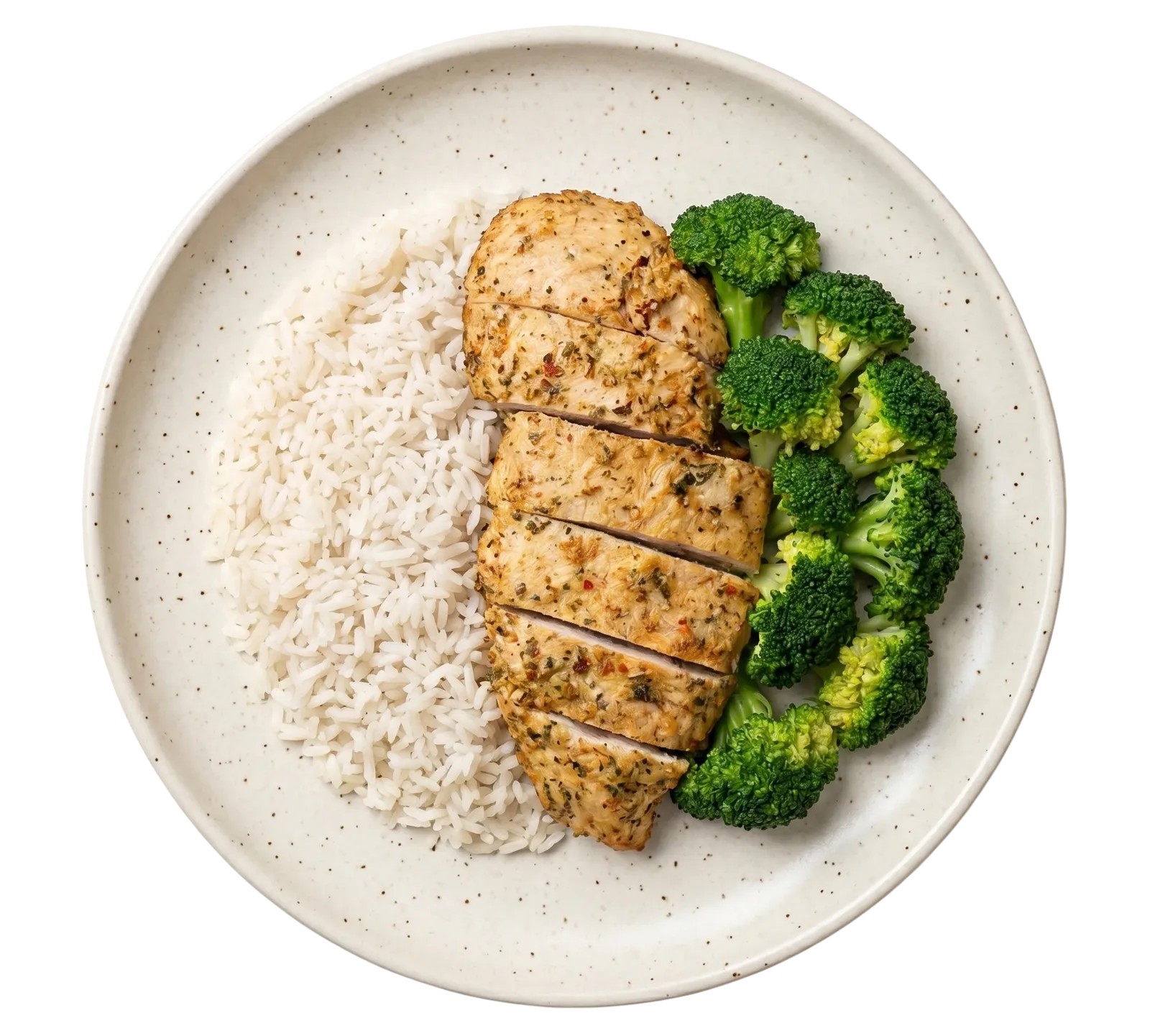
what a weight-loss meal actually looks like (real numbers)
the frame that works for a main meal: 400 to 600 calories, 40 to 55 grams of protein. filling and muscle-protecting, with room left in your day. here are real numbers off our menu rather than a generic template.
our beef and sausage meatballs are close to the ideal weight-loss plate: 52 grams of protein, 480 calories, only 18g of carbs and 7.5g of fiber. high protein, high fiber, moderate calories. it is hard to build a better deficit meal than that.
our lemon honey chicken lands at 52 grams of protein for 610 calories with 7g of fiber, and the golden orange chicken at 50 grams for 670 when you want the bigger plate.
and the snacks matter just as much, because the deficit dies in the gaps between meals. the egg bites at 12g protein for 151 calories, the brewski protein drink at 24g for 166, and even the macro chip cookie at 9g for 190 are the tools that keep you full between meals without blowing the day.
a realistic day in a deficit, no cooking required
not a rigid plan, just proof the numbers work when the food already did the work. this lands around 1,600 calories and 130 grams of protein, a solid deficit for many adults with plenty of protein to hold muscle.
breakfast. two egg bites and a brewski. 36g protein, roughly 470 calories. (more on this in our guide to a high-protein breakfast you don't have to cook.)
lunch. beef and sausage meatballs. 52g protein, 480 calories, and you are full for hours.
dinner. lemon honey chicken. 52g protein, 610 calories.
if you need it. a macro chip cookie for 9g protein and 190 calories, so the "I want something" moment does not turn into a delivery order.
no meal-prep marathon, no measuring, no 1,200-calorie misery. just portioned, labeled food that adds up on its own.
if you are on a GLP-1, this still applies (with one twist)
if you are taking ozempic, wegovy, mounjaro or zepbound, everything above holds, with one extra wrinkle: your appetite is smaller, so hitting your protein is even harder because you simply cannot eat as much food.
that makes protein density the metric to chase. every bite has to carry more protein, because you get fewer bites. our GLP-1 guides go deep on this: start with what to eat on ozempic, then protecting muscle while you lose weight and hitting 100g of protein without trying.
where to get weight-loss meal prep in the twin cities
this is exactly what we cook for. tandoco is a Minneapolis kitchen making high-protein meals and a wellness bakery with protein, fiber, gluten-free and vegan options, delivered across the Twin Cities metro.
you order by thursday at 11:59pm and it arrives sunday, so a full week of portioned, protein-forward meals is in your fridge before the week even starts. every calorie and gram of protein is printed on the item, so you are never guessing what a meal costs you. no cooking, no measuring, no willpower tax.
browse this week's menu to build your week, and if you like knowing the math, our twin cities macro grocery list and macro tracking for people who have never counted are good next reads. wondering if it is worth the price versus cooking yourself? we broke that down in is meal prep worth it.
FAQ
Does meal prep actually help you lose weight?
Yes, for a specific reason. Weight loss comes down to a sustained calorie deficit, and the thing that breaks most deficits is not a lack of knowledge, it is decision fatigue and hunger at the end of a long day. Prepping meals ahead removes the daily decisions and makes the high-protein, portion-right option the easy one, which is what actually keeps a deficit going week after week.
How much protein should I eat to lose weight?
A common target is roughly 0.7 to 1 gram of protein per pound of your goal bodyweight. Protein matters in a deficit for two reasons: it is the most filling macronutrient, so it curbs hunger, and it protects muscle so the weight you lose is fat, not muscle. That is why weight-loss meal prep is really high-protein meal prep.
How many calories should a weight-loss meal be?
There is no single number, but a useful frame is 400 to 600 calories per main meal with 40 to 55 grams of protein, so you get filling, muscle-protecting food while leaving room in your day. tandoco beef and sausage meatballs (480 cal, 52g protein) and lemon honey chicken (610 cal, 52g protein) are built around that math.
Is meal delivery good for weight loss?
It can be, if the food is portion-controlled and protein-forward and every macro is labeled. The risk with generic delivery is oversized, carb-heavy portions. tandoco prints the calories and protein on every item, so you always know exactly what a meal costs you.
Do I have to be on Ozempic or a GLP-1 for this to work?
No. High-protein, portion-controlled meal prep is the foundation of weight loss for everyone. GLP-1 users have an extra reason to lean on it (smaller appetite, harder to hit protein), but the same food works whether or not you are on a medication.
Do you deliver weight-loss meals in the Twin Cities?
Yes. tandoco is a Minneapolis kitchen cooking high-protein meals and a wellness bakery, delivered across the Twin Cities metro. Order by Thursday at 11:59pm and it arrives Sunday, a full week of portioned, labeled meals ready to heat.
this is general nutrition information from a Minneapolis meal-prep kitchen, not medical or weight-loss advice. sustainable weight loss is individual, and if you have a medical condition, an eating disorder history, or you are unsure where to start, talk to your doctor or a registered dietitian.