the fiber problem on ozempic nobody warns you about.
short answer: if you are on ozempic, wegovy, mounjaro or zepbound and you are backed up, it is usually not the medication being cruel to you. it is that you are eating a lot less food than you used to, and fiber left the plate along with everything else. aim for about 28 to 34 grams of fiber a day, get at least half of it from soluble fiber, add it slowly (roughly 5 grams a week), and drink more water than feels necessary. that fixes it for most people.
here is the part nobody warns you about at the pharmacy counter. about 30 to 40 percent of people on a GLP-1 end up constipated, usually in the first few weeks or right after a dose bump. it is the second most common complaint after nausea, and unlike nausea, it does not really fade on its own. it just quietly becomes your new normal until you do something about it.
why a GLP-1 backs you up in the first place
the whole reason these medications work is that they slow down how fast food leaves your stomach. that is the magic. it is why one meal holds you for six hours instead of two, and why you stop thinking about snacks.
it is also, unavoidably, why things slow down further along. same mechanism, different end of the system. you cannot really have the appetite effect without some version of the plumbing effect.
so the goal is not to fight the medication. it is to make the smaller amount of food you are now eating work a lot harder for you.
how much fiber you actually need (and why the standard number misleads you)
general guidance for adults is 25 to 38 grams a day. on a GLP-1 the practical sweet spot lands around 28 to 34 grams, with a bias toward soluble fiber.
but the number is not the interesting part. here is the interesting part: the average american eats about 15 grams a day, which is already only half of the target. now cut your total food intake by a third because you are barely hungry. you are suddenly eating maybe 10 grams a day without changing a single thing about what you choose to eat.
that is the real story of GLP-1 constipation. you did not start eating badly. you started eating less, and fiber got cut proportionally along with everything else.
the metric that actually matters: fiber per bite
this is where most fiber advice falls apart for people on a GLP-1.
"eat more vegetables" assumes you have room. you do not. telling someone on week six of mounjaro to eat a giant salad is like telling someone with a small suitcase to just pack more. the suitcase is the constraint, not the packing strategy.
so stop optimizing fiber per plate and start optimizing fiber per bite. every mouthful has to carry protein and fiber at the same time, because you only get a limited number of mouthfuls now.
the foods that win on that math: beans and lentils, chia and flax, oats, raspberries and blackberries, avocado, and whole grains. the foods that lose: lettuce, celery, rice cakes, most "light" versions of things. bulky, low density, and they eat your stomach space without paying rent.
soluble vs insoluble, in plain english
you will see these two words everywhere and they matter more on a GLP-1 than off it.
soluble fiber dissolves in water and forms a gel. that gel is what softens things and keeps them moving. oats, beans, chia, psyllium, apples, citrus. this is the one you want to lead with when you are constipated.
insoluble fiber does not dissolve. it adds bulk and speeds transit, which sounds perfect until you realize that on a slowed-down system, adding bulk without enough water can make you feel worse, not better. wheat bran, raw leafy greens, vegetable skins.
you want both, but if you are currently backed up, lean soluble first. at least half your daily fiber, more if you are struggling.
the ramp-up rule (this is where people wreck themselves)
almost everyone makes the same mistake. they read an article like this one, decide to fix it today, and go from 10 grams to 35 grams in a single afternoon.
then they spend two days bloated, gassy and miserable, decide fiber made everything worse, and quit.
fiber needs a gradual on-ramp, especially on a GLP-1 where transit is already slow. add about 5 grams per week. that is one serving of beans, or a tablespoon of chia, or one high-fiber item added to your day. hold there for a week. then add the next 5.
and the water is not optional. every 5 to 7 grams of added fiber wants a full glass of water alongside it. soluble fiber without water is the single fastest way to make constipation worse instead of better, because you are adding the gel-former and withholding the thing it needs to become gel.
what high-fiber actually looks like when you are barely hungry
this is the stuff we cook for, so here are real numbers off our own menu rather than a generic list.
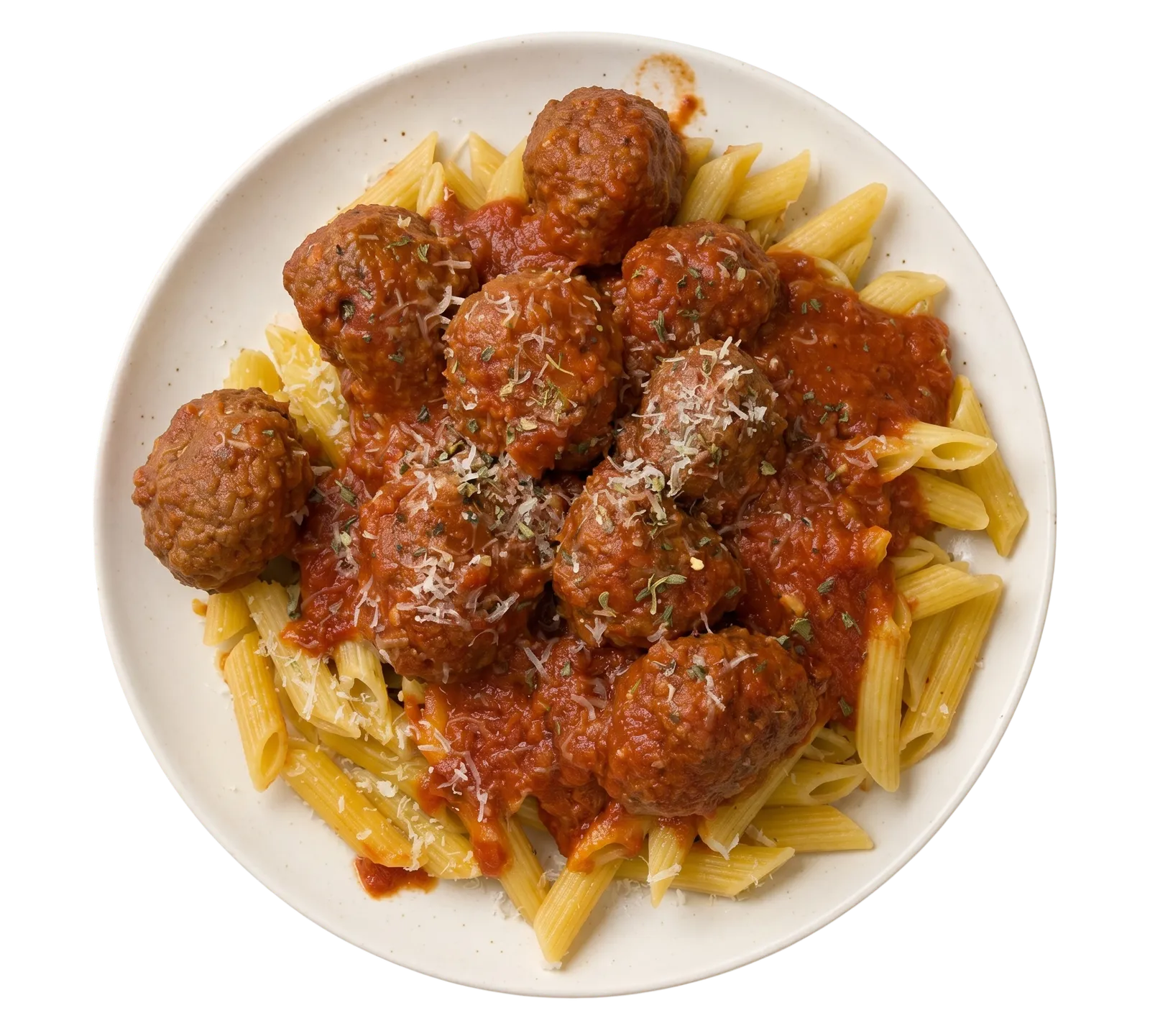
our beef and sausage meatballs run 52g protein and 7.5g fiber at 480 calories, with only 18g of carbs. that is close to a perfect GLP-1 plate: a quarter of your daily fiber and half your daily protein in a portion you can actually finish.
our lemon honey chicken lands at 52g protein and 7g fiber. our pumpkin fiber muffin is the one we built specifically for this problem, at 8g of fiber in a single muffin, which is more fiber than most people get from an entire breakfast. the cloud nine roll carries 4g.
stack a meatball entrée and a pumpkin muffin in one day and you are at roughly 15 grams of fiber from two items, without eating a single thing that feels like health food homework.
a realistic day at about 30 grams
not a meal plan, just proof that the number is reachable when every item pulls its weight.
morning. a pumpkin fiber muffin (8g) with coffee. that is a quarter of your day handled before you have made a single decision.
midday. half a cup of black beans added to whatever you are already eating (7g), or a chia pudding (about 10g per two tablespoons of chia).
evening. a meatball entrée (7.5g) or the lemon honey chicken (7g).
anywhere. a cup of raspberries (8g) is the single highest-fiber fruit per bite and it is not close.
that is 30 grams without a salad in sight, and roughly 100 grams of protein along the way, which matters just as much (see our guide on protecting muscle while you lose weight on a GLP-1).
when it is not a fiber problem
worth saying plainly: fiber and water fix most GLP-1 constipation, but not all of it.
if you have gone a week with no movement at all, you have severe pain or bloating, you are vomiting, or nothing improves after two weeks of doing everything above properly, that is a call to your prescriber, not another article. dose adjustments are a real option and so are short-term medical treatments. we cook food, we are not your doctor, and this is one of those places where the line is worth drawing clearly.
where to get high-fiber, high-protein food in minneapolis without cooking
this is the whole reason tandoco exists. we are a Minneapolis kitchen cooking high-protein, healthy meals plus a wellness bakery with protein, fiber, gluten-free and vegan options, delivered across the Twin Cities metro.
you order by thursday at 11:59pm and it arrives sunday. no cooking, no meal-prep marathon on a day you have no appetite anyway, and every macro (including fiber) is printed on the item so you are never guessing.
browse this week's menu, or the wellness bakery if the muffin is what you came for. if you are newer to all of this, start with what to eat on ozempic, then how to hit 100g of protein without trying. and if nausea is your bigger battle right now, the foods that settle it are covered separately.
FAQ
How much fiber should I eat per day on Ozempic or Wegovy?
Most adults are told 25 to 38 grams a day. On a GLP-1 the practical target is about 28 to 34 grams, with at least half of it from soluble fiber like oats, beans, chia and psyllium. Get there gradually, roughly 5 extra grams per week, and drink more water as you go.
Why does Ozempic cause constipation?
GLP-1 medications work partly by slowing how fast food leaves your stomach. That is the same mechanism that keeps you full for hours, and it also means everything moves through you more slowly. Roughly 30 to 40 percent of people on a GLP-1 report constipation, and it usually shows up in the first few weeks or after a dose increase.
Is fiber or water more important for GLP-1 constipation?
Neither works well alone. Fiber without enough water can actually make you more backed up, because soluble fiber needs water to form the gel that keeps things moving. Pair every 5 to 7 grams of added fiber with a full glass of water.
Can I just take a fiber supplement instead of eating high-fiber food?
A psyllium supplement is a reasonable backup if food changes have not helped after a week or so, and many people do use one. But food does two jobs at once on a GLP-1: fiber plus protein in the same bite. A supplement only does one. Start with food, add the supplement if you still need it, and talk to your prescriber.
What foods have the most fiber for the least stomach room?
Beans and lentils, chia and flax, raspberries and blackberries, oats, avocado, and whole grains. On a GLP-1 the metric that matters is fiber per bite, not fiber per plate, because you are simply not going to finish a giant salad.
Do you deliver high-fiber meals in Minneapolis?
Yes. tandoco cooks high-protein meals and a wellness bakery in Minneapolis and delivers across the Twin Cities metro. Order by Thursday at 11:59pm and it arrives Sunday.
this article is general nutrition information from a Minneapolis meal-prep kitchen, not medical advice. GLP-1 medications are prescription drugs with real side effects. talk to the person who prescribed yours before making changes.